
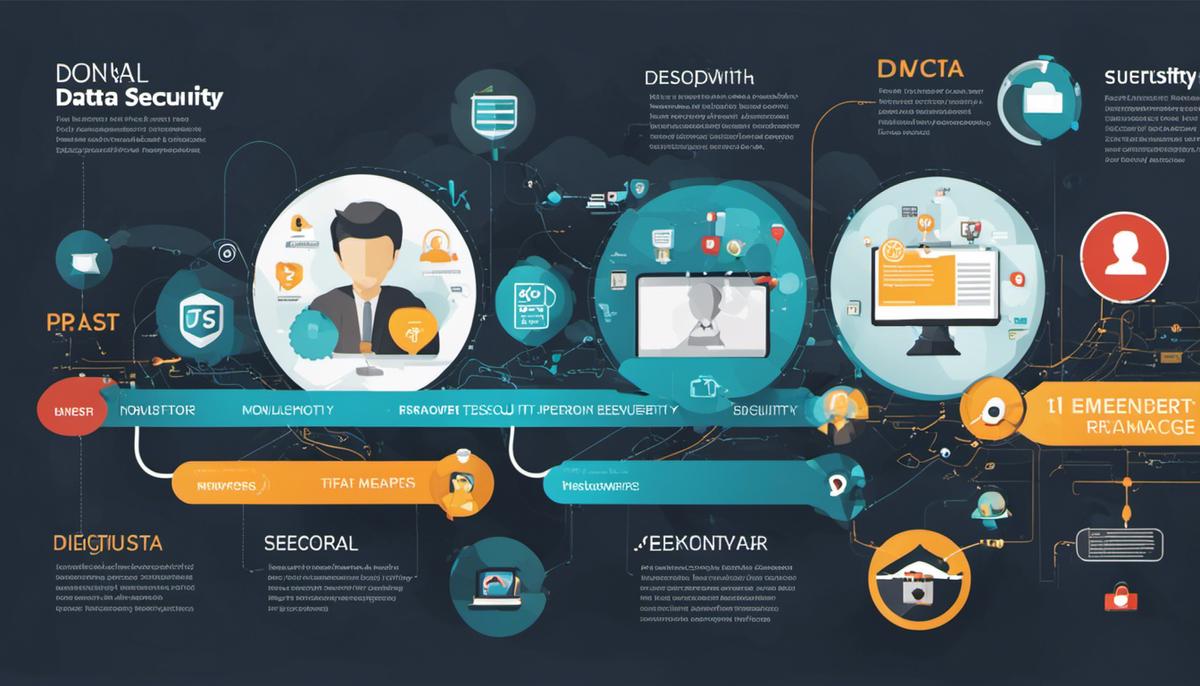
Living in a digital age where every piece of information can be accessed at a moment’s notice, the significance of personal data security has never been higher. The evolution of security technologies is intertwined with the proliferation of the internet and digitization, forming not only a protective wall around sensitive data but also an intriguing narrative of continuous innovation and adaptation. While a grandeur of advancements has been made in the sphere of data security, prominent threats persist, coming in forms such as phishing attacks, malware, and ransomware, capitalizing on the slightest vulnerabilities in the system. But with the dawn of modern protective technologies such as artificial intelligence, encryption methods, and blockchain technology, the battle against cybersecurity threats is being fortified. Moreover, implementing tried and true practices like routine software patches, rigid password regulations, two-factor authentication, and frequent security audits can radically improve personal data protection.
The Evolution of Personal Data Security
Unfolding the Phases of Personal Data Security with Advancing Technologies
In the realm of technology, change is the only constant, and one area that exemplifies this is personal data security. Since the rise of the digital age, data security has persistently evolved, transforming in complexity and efficiency in tandem with the progression of technology. This reciprocal relationship empowers our defense against ever-advancing cyber threats, marking a notable transformation in personal data security.
The journey of data security began with simple password protection methods. As technology platforms started developing, the need for personal data security stimulated the creation and use of alphanumeric passwords. Initially, these rudimentary yet effective protective measures marked the first step towards the automation of data security processes, aligning with individual privacy concerns.
Fast forward to the early internet era, when the concept of data security took a significant leap with the incorporation of encryption. Normal text started getting converted into an illegible format, a process that could only be reversed with a unique decryption key. This technological advancement allowed secure data transmission over the internet, erecting a formidable barrier against data breaches.
Further and faster, the technology sprinted into the age of multifactor authentication. It was realized that passwords and encryption alone were not enough to combat increasingly sophisticated cyber threats. Here, multifactor authentication emerged as a comprehensive solution that demanded additional input, like fingerprints or facial recognition along with the password. This not only meshes human and digital resources but also significantly reduces instances of data theft, refining the personal data security landscape.
The continued sophistication of technology propositioned new areas of concern and, in the spirit of innovation, offered the solutions. With the dawn of smartphones and the ubiquity of applications, our personal data found a new residency. Security measures evolved to meet this challenge, employing end-to-end encryption strategies for secure communication services and containerization techniques for application data security.
Simultaneously, artificial intelligence stepped onto the field, altering the data security narrative. Machine learning was unleashed on cyber threats, with brilliant algorithms capable of identifying, predicting, and neutralizing malicious activity before any harm could be done. Advancements like behavioral biometrics further complicated the task for potential cybercriminals, making personal data security more fluid and dynamic.
As we immerse into the age of quantum computing, new challenges and answers await us. Quantum cryptography and quantum-resistant algorithms are gradually penetrating into the market, hinting at a future where personal data security could boasts of more robust, unaffected integrity.
Analyzing the significant touch points in this journey, we witness the intertwined evolution of technology and personal data security. Each upgrade in technology has paved the way for a subsequent boost in data security measures, and each leap in data protection has propelled technological breakthroughs. As enthusiasts who thrive on advancement and automation, this transformative journey underscores the uplifting potential of technology, reaffirming our faith in its capacity to solve problems and secure futures. And as we tread further into the realm of technological advancements, the evolution of personal data security promises to keep pace, adhering to its primary object: protecting the privacy of the individual.

Key Threats to Personal Data Security
Building on the foundation laid, it’s time to discuss some major threats posing a risk to personal data security in the contemporary digital age. The rapid progression of technology, while beneficial, has also opened up new avenues for cyber attacks. Three main areas have surfaced as significant threats: social engineering, Internet of Things (IoT) vulnerabilities, and machine learning exploitation.
Firstly, social engineering, which involves manipulating individuals into surrendering confidential information, has increasingly become a serious threat to personal data security. This type of attack is psychological in nature, exploiting human vulnerabilities rather than technological ones. For example, phishing attacks- emails crafted to appear authentic and prompt the recipient into divulging private information, is an oft-used social engineering strategy. Viruses and malware can also piggyback on such emails, infiltrating devices once these emails are opened. Social media platforms are addition areas rife with opportunities for social engineering attacks, with fake profiles and messages serving as bait.
Then, we have the pitfalls surrounding the Internet of Things (IoT). IoT devices transcend smartphones and computers; they encompass smart homes, wearables, and connected cars. This pervasiveness escalates the risk factor. IoT devices collect and transfer vast amounts of personal data, making them attractive targets for cybercriminals. However, many of these devices lack strong security features, easily overridden by more sophisticated attackers. Furthermore, being interconnected, a breach in one device could easily lead to compromises in others within the network. Without robust security protocols for these devices, the IoT landscape will continue to be a significant threat to personal data security.
Lastly, the exploitation of machine learning poses a significant threat. Machine learning algorithms are employed to enhance security measures, devising more efficient ways to counter cyber threats. Attackers have caught on, and have started using these algorithms to inception more potent attacks. By corrupting, falsifying, or manipulating input data, they can lead the system astray, leading to flawed output which can compromise security efforts. This, coupled with the current inability of these algorithms to fully explain how they have reached their decisions, escalates the risk of undetected security breaches.
In conclusion, bolstering personal data security involves staying abreast of these threats and proactively finding solutions. This requires a combination of technological know-how, a sharp understanding of human behavior, and the scrutiny of new developments in the tech industry. It’s a never-ending game of cat and mouse with cyber threats, but every step forward fortifies the wall of digital safety. Remember – in the realm of personal data security, complacency is not an option. Stay vigilant!
Modern Technologies for Personal Data Security
In prowling the veritable frontier of personal data protection, advancing tech solutions have materialized, each with potential to lend a securing hand in this increasingly nebulous data ecosystem.
Looking from the molecular level, bio-metric solutions are swiftly gaining momentum. This technology capitalizes on unique physical characteristics—like fingerprints, retinal patterns, or facial geometry—rendering data virtually inseparable from the user. This solution trades the forgettable password for wholly unique identifiers. However, it’s paramount to comprehend the implications of an irreversible identifier. Once compromised, physical characteristics can’t merely be updated akin to a redundant password.
Smart Contract technology, another contemporary champion, extends beyond traditional encryption and multi-factor authentication. Vaccinating against impersonation and verifying authenticity in online interactions, Smart Contracts are self-executing transactions with the consent outlined in code form. Originally conceived for blockchain technology, they’ve valuable ramifications for data security, potentially eliminating fraudulent activities and reducing cyber threat’s efficacy.
A vital tool in the current data security arsenal is Virtual Private Networks (VPNs). Essentially bridging distance with a secure line of transmission, VPNs create encrypted tunnels between the user and their network. This makes it nearly impossible for potential threats to intercept data transmissions, thereby bolstering security when utilizing public networks.
Blurring reality and the digital, Augmented Reality (AR) technology can fortify data security with three-dimensional, heuristic passwords, dissolving the boundaries between the physical and digital worlds. Traditional text or pattern-based passwords could morph into touch, gesture, or voice-activated commands that require the presence of the user. It’s an enticing concept that leverages AR’s potential to create layered, personalized defenses around sensitive data.
Innovation in data distribution, like Data Sharding, segments and disseminates data across multiple locations. This means a breach doesn’t provide access to a complete set of information, creating a further obstacle for cyber threats. Similarly, Homomorphic Encryption permits data usage for computation without actual access to the core data, another formidable stronghold.
Let’s not overlook Blockchain, with its decentralized ledger system. In this integrity pact of encrypted information, each new entry is linked chronologically to the ones before it. Consequently, tampering with data is detectable instantly and becomes virtually impossible without altering all subsequent entries.
Ultimately, as technology evolves, so do potential threats. The balance between accessibility and security is a challenging one. Therefore, adaptability remains crucial to data security with the rise of emerging tech. Today’s solutions serve as highly effective tools in the present, but it’ll be the tech enthusiasts, the early adopters, the innovators and creators who will sculpt the landscape of personal data security for the future. Technology is integral to combating data security challenges; wariness, wisdom, and ongoing adaptation will dictate technology’s efficacy in this battle.
Best Practices for Ensuring Personal Data Security
In the unending battle for personal data security, the proactive adoption and knowledgeable implementation of technology is vital. A robust, multifaceted approach to thwarting data compromises, uniting technological tools with practical preventative practices, is acceptable for this era of advanced cyber threats.
Bio-metric technology offers a promising leap in personal data security. Rather than relying on easy-to-crack passwords, biometric solutions like fingerprint scanning, retina display, or voice recognition provide more reliable, unique identifiers for secure access to personal data.
Smart Contracts, built on blockchain technology, also provide a significant solution for personal data security. By automatically executing transactions only when pre-set conditions are met, they eliminate the chance of fraud, providing robust security measures.
Virtual Private Networks (VPNs) are essential for anyone serious about their online security. VPNs create encrypted connections over less secure networks, masking IP addresses and safeguarding data from potential interception or leakage, crucial when using public internet access points.
Moreover, the potential of Augmented Reality (AR) technology has been tapped for layered, personalized defenses. By using AR, individuals can create virtual protective barriers for their personal data, pairing physical security protocols with digital ones.
Data distribution techniques, like Data Sharding and Homomorphic Encryption, work to combat threats of data breaches by breaking up and encrypting data in new ways. Data Sharding separates larger databases into smaller, more manageable parts that are less vulnerable to attacks. Homomorphic encryption, on the other hand, allows computations to be carried out on encrypted data without first having to decrypt it.
Lastly, data security turns towards a decentralized approach with the rise of Blockchain technology. A secure, transparent ledger system that isn’t controlled by a central authority provides improved data security, as every transaction can be traced, monitored, and verified.
However, amid all these advancements, one thing must remain consistent: the need for adaptability. Evolving cyber threats require ongoing adaptation, both in personal practices and technology. Keeping software and hardware up to date, regularly changing passwords, applying multi-factor authentication, avoiding unsecured networks, and staying informed about emerging threats form the pillars of this continual endeavor.
In the world of data security, there are no absolutes. It’s a continuous stride towards a moving finish line. Nonetheless, harnessing these technologies and practices, keeping the line of progression unfaltering, one can significantly mitigate threats to personal data security. It’s the amalgamation of informed use and tech-integration that will sway the balance in favor of individuals striving to protect what’s rightfully theirs in the virtual world.
Ultimately, with the rampant digitization and increasing connectivity, personal data security has escalated from being optional to a non-negotiable necessity. As we all find ourselves immersed and intertwined with technology, understanding the threats we face and the solutions available is vigorously crucial. The risk landscape may bristle with threats like phishing and ransomware, but equipped with advanced technologies such as AI and blockchain, and armed with strategic best practices like strong passwords and regular updates, we can create a robust defence line. The responsibility of protecting our data lies within each one of us, emphasising the cardinal principle, security isn’t just a concept; it’s a continuous, evolving process.